We caught up with Yeong Weng Fai, director of DP Green (DPG), the Landscape & Arboricultural Consultancy arm of DP Architects and its group of companies, as it celebrated its 10th Anniversary.
NEWS
DP Green
Celebrates 10 Years
Published on
Sprouting from Humble Beginnings
DPG was officially inaugurated on the 5th July 2010 at the now-defunct “Old School”, inspired by its former occupant – Methodist Girls’ School, on Mount Sophia. At the time, it was re-purposed to house various design-oriented practices and boutiques such as architects and designers in the fields of graphic, advertising and fashion.
These were the formative years where we strived to achieve an identity and a foothold in the industry through our inter-disciplinary team, which comprised landscape architects, architects, arborists and horticulturists. We were a predominantly “young” team then, with many who had freshly graduated from tertiary and polytechnic institutions, both locally and abroad. We were also united in the shared ethos that architecture and landscape were inextricably linked. So while the learning was steep, especially as we took on international projects as part of DP Architects and its group of companies, we were committed to collaboratively crafting well-thought-out, holistic design solutions for our clients. And still are a decade on!
We made the conscious decision to allow our ideation and creative processes to be unbridled but tempered by the hands of older, more experienced team members; harnessing the creative prowess and energy of every individual within their respective discipline. Our team mentality was that every project – big or small – is an opportunity to learn. Over the course of the last decade, we have handled a diverse gamut of project typologies in different socio-geographical locations, which has allowed us to glean knowledge and widen our expertise.
Thinking back… “Old School” provided us with a fresh and conducive environment to develop our design language, technical capabilities and business strategies… Did you know that there was even a small cinematographic theatre, SINema there? It occupied the converted school hall and would only air films that were locally produced.
Growing and Developing Strengths
DPG’s inauguration as an arboricultural consultancy added credibility to our architectural practice. It was also, and we believe still is, a design service that is complementary to architecture. This is especially so in Singapore where steady intensification of the urban greening efforts aims to transform the island-nation from “City in a Garden” into a “City in Nature”. This is also quite pertinent with the issue of global warming and passive energy solutions where landscaping and provision of green cover, in many ways, collectively help to counter the heat island effect in highly urbanised cities and minimise dependency on active cooling practices. Together with water scarcity and the desire to create a verdant tropical living environment for Singapore, our arboricultural and horticultural expertise enables informed landscape designs with regards to species selection and a bio-diverse habitat creation which some projects call for.
In addition, BCA‘s initiative on Building Information Modelling (BIM) pushed our technical capabilities in tandem with DP’s architectural practice. We were one of the first landscape consultancy firms to be BIM-enabled and recognised. Our first foray into BIM was through Sengkang Hospital Campus. To gain greater stronger competency, we moved some of our staff to Parkview Square in order to acquire the CAD (Computer-Aided Design) skills with our architectural counterparts and that is truly the DP esprit-de-corps in action.
Landscape consultancy services have somewhat evolved into providing prime marketing strategies and selling points, particularly for the residential market in the past decade. As such, large-scale, residential landscape design become more competitive in terms of creating innovative marketable thematic designs as a selling edge for developers to entice buyers. Hence, we learned to raise our expertise, not only in terms of highly eye-catching presentation materials for sales brochures where our staff have garnered and acquired specialised skills in various CAD programmes, but our designers are also experienced in conceptualising innovative, original and creative design ideas that set the development apart.
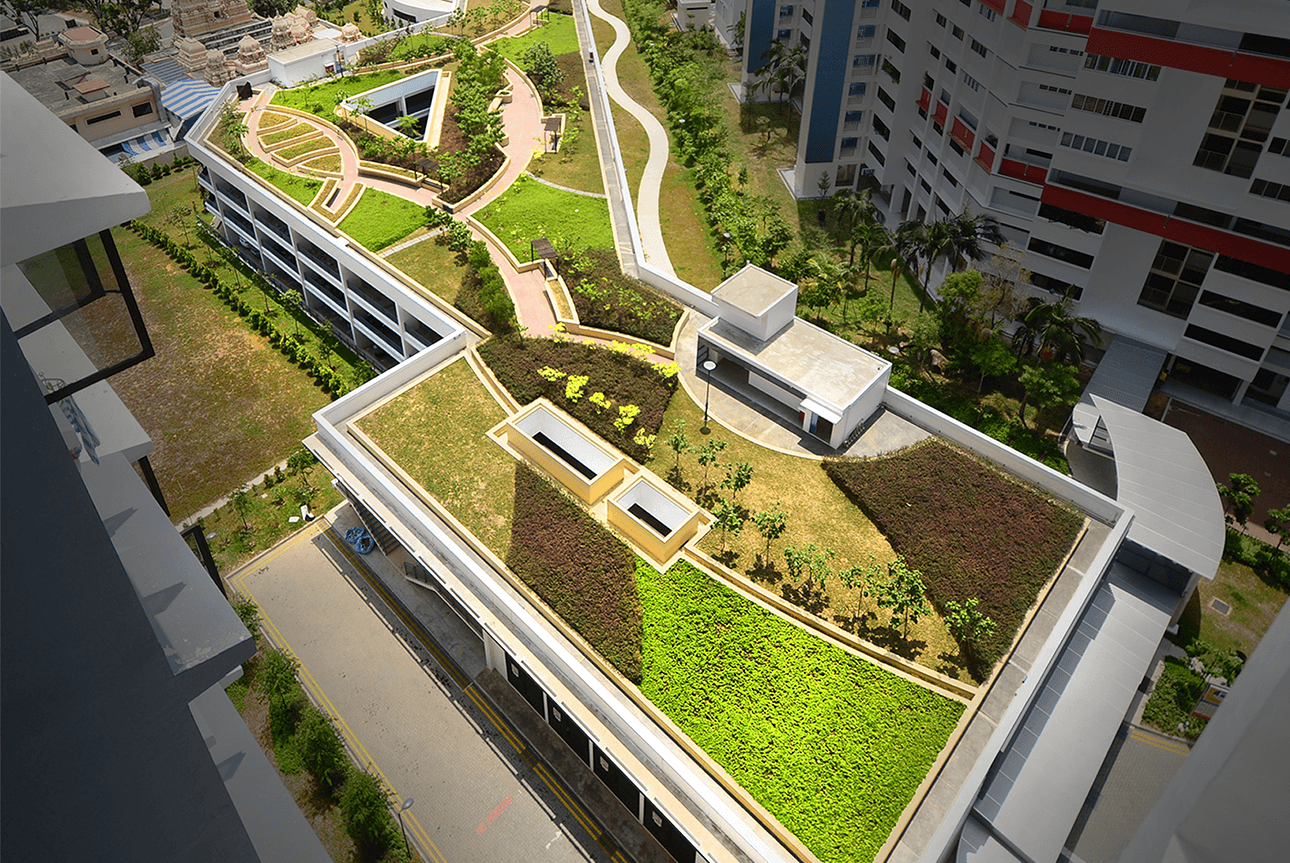
Marsiling Heights (Woodlands NIC19) is DP Green’s first project for the Housing Development Board since its inception. Here, DPG brought the concept of a communal garden with herbs, spices and fruit trees even before urban farming became a trend.
First Seeds
I believe the first project for DPG as a registered company was also our first project for the Housing Development Board (HDB) of Singapore. The project, Marsiling Heights or Woodlands NIC19 at Marsiling Road/Marsiling Rise, was coincidentally also DPA’s foray into project tenders for HDB. This was a small project comprising three 31-storey blocks with a de rigueur multi-storey car park (MSCP) and was a design exercise in creating meaningful outdoor spaces for the community, particularly for the MSCP roof where we played with the geometry of circles to circumscribe paths and planting beds, interspersed with rest points of vine-covered pergolas over built-in benches. This was done way before urban farming and food security became buzz-words. We also specified several varieties of fruit trees and spice/herb plants for this communal roofscape.
Another noteworthy project is Four Acres Singapore at Nepal Hill. It was Unilever’s first global Leadership Development facility outside of the UK. Situated within JTC ‘s One-North masterplan, the design of this complex exemplifies what one would describe as topographic architecture, integrating the land on which it sits with the built form, linking the landscape with the architecture. This was achieved with its roof form that seemingly emerges at the entry block and dramatically sweeps up to the administrative and teaching blocks, as a result of the topographical and building level changes. As part of the masterplan guidelines, the roof fulfils the requirement of a unifying “green ribbon’’ for the architecture with its extensive greening, blending naturalistically with the existing wooded environment of this historic colonial enclave.
Apart from this, there were many valuable old trees conserved, one of them being Fragrae fragrans or Tembusu and many other indigenous species. Part of the softscape strategy was to augment the existing species with related species, enriching the forest-scape with more texture and colour in leaf-form and adding the dimension of scented-flowering species to complement the Tembusus. The development also entailed the conservation of several colonial black-and-white bungalows where thematic planting designs enveloped outdoor “garden rooms” for participants or guest speakers. We were also delighted to win the SILA Gold award that year in 2015 and the LIAS Gold award (Greenwall) for this joint collaboration with DPA.
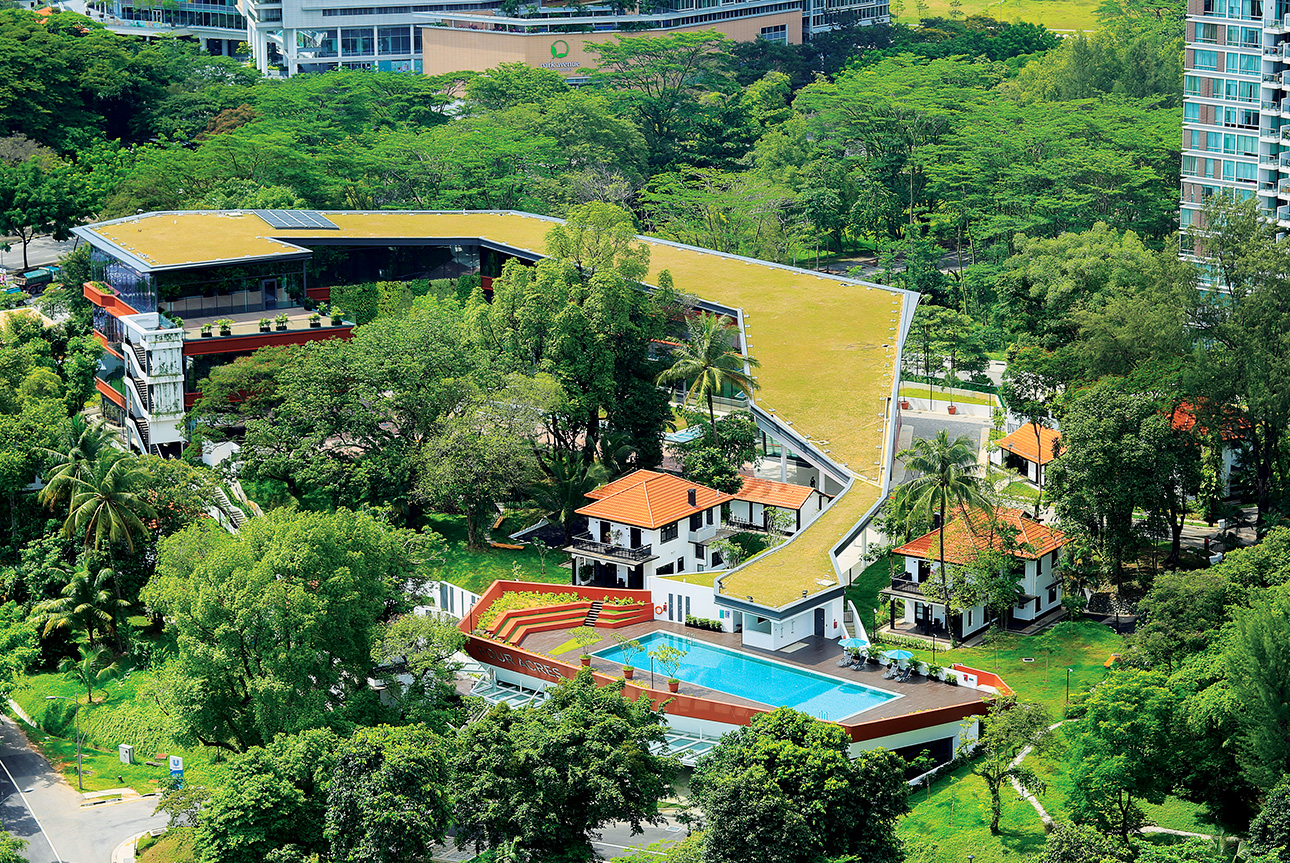
Four Acres exemplifies topographic architecture which integrates the land with the built form.
All Green Ahead
Today, landscape architects and architects have an even more pertinent role to play in re-envisioning and sculpting our natural and urban environment. Convalescing the COVID-19 pandemic, there is a continued emphasis on sustainability and biophilia as well as a growing palpability of urban farming techniques. The pandemic has also pushed governments to initiate and seize the opportunity to implement what has been termed the “Green Recovery” movement. It involves creating more outdoor spaces, parks, accelerating tree planting for carbon sequestration, better cycling amenities, connectivity and alternative modes of commuting. We are also seeing conversions of car park lots and the “car-lite” idea into parks and outdoor recreational amenities as social interaction is still a necessary and vital part of human activity. Outdoor spaces — with fresh air, sunshine and greater safe-distancing afforded, with less likely surface areas for the virus to thrive — have become safe havens, where people are realising the need to exercise and maintain a physical and mental state of health is absolutely critical.
As such, this augers well for the Landscape industry where we will continue to play an important and demanding role in co-creating and re-imagining our outdoor spaces, together with architects, urban planners, environmental engineers, ecologists, sociologists, etc. We believe the umbrella of involvement and collaboration between different disciplines, the notion of “co-design”, will become wider as we grapple to arrest, improve and innovate to change our living environment to counter future pandemic situations. My hope is that DPG and the DPA group will continue to move in tandem to have cutting-edge design for the betterment of human life.